Showing posts with label Italy. Show all posts

Florence, the City of Romance

Florence is the capital of the Tuscany region in Italy. Florence is famous for its rich history: a centre of medieval European trade and finance and one of the wealthiest cities of the time, it is considered the birthplace of the Renaissance. The city is noted for its culture, Renaissance art, artistic architecture and monument, and has been ranked by Forbes as ont of the most beautiful cities in the wold, and also declared as a World Heritage site by UNESCO. It is also one of my favourite cities in the world! 


Piazzale Michaelangelo

This is one of the MUST DO in florence - sunset viewing from Piazzale Michaelangelo. It is atop a hill that overlooks the entire city and gives a panoramic view. Every evening, tourists flock here for a breathtaking view of the sunset against this beautiful city. 


Awww, how romantic, taking wedding shots in the sunset in this romantic city.


Here's the legendary statue of David by Michaelangelo.
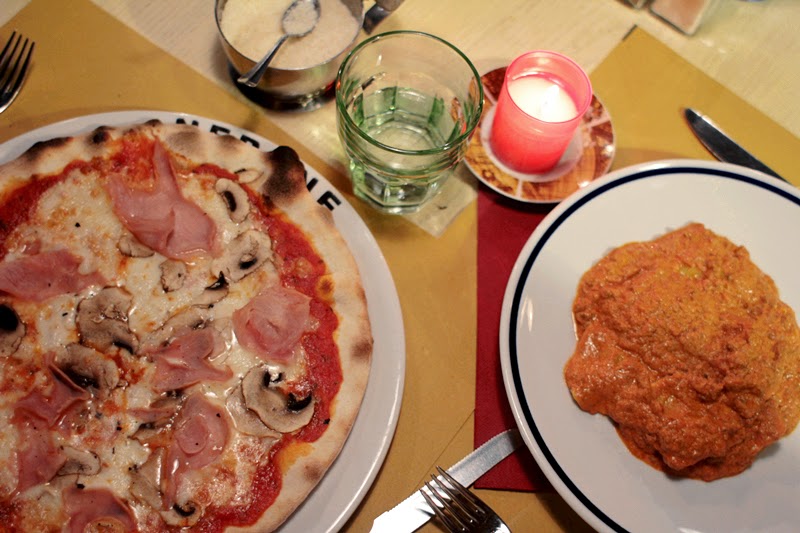
Every meal was pizza and pasta. The food was so good that I couldn't get sick of eating it! 


Academia Gallery
Academia Gallery is one of the most popular museum and we had to queue early to get tickets as it would get crowded later in the day. Tickets are at 15euros and the ticket office is just steps away from the Academia Gallery.

Former hospital in the 14th century, then an Academy of Fine Arts, it houses ”David”, the absolute masterpiece by Michelangelo, a must for all visitors of Florence. Sculpted between 1501-1504 to be an outside decoration of the Cathedral of Florence, it became instead a symbol of the commitment of the Florentine State to freedom and independence, as well as a symbol of the Medici's defeat in 1494. It still personifies energy, vigour and courage, symbolizing the whole mankind fighting for survival. His anatomy, later reproduced by Michelangelo’s contemporaries, was carefully depicted, thanks to the in-depth studies carried out by the great artist. In addition to David, 4 statues of the Slaves commissioned by Pope Julius II as a decoration of his grave, the “Mourning over Jesus Christ” and “St. Matthew”. The museum houses an interesting collection of paintings from the Middle Ages, Renaissance and early 17th century.
(Wikipedia)


Duomo di Firenze

Florence's Duomo is the city's most iconic landmark. Capped by Filippo Brunelleschi's red-tiled cupola , it's a staggering construction whose breathtaking pink, white and green marble facade and graceful campanile (bell tower) dominate the medieval cityscape. Sienese architect Arnolfo di Cambio began work on it 1296, but construction took almost 150 years and it wasn't consecrated until 1436. In the echoing interior, look out for frescoes by Vasari and Zuccari and up to 44 stained glass windows.
The Duomo's neo-Gothic facade was designed in the 19th century by architect Emilio de Fabris to replace the uncompleted original, torn down in the 16th century. The oldest and most clearly Gothic part of the cathedral is its south flank, pierced by Porta dei Canonici (Canons' Door), a mid-14th-century High Gothic creation (you enter here to climb up inside the dome).
(Lonelyplanet)


Got tickets for the climb to the top of the duomo - it was quite hard to find as it's tucked in between rows of shops. Had to ask a few locals before finding the ticket office, which was located in one of the galleries. 

Majestic view of the interior of the dome, painstakenly hand-painted by the artist. Couldn't imagine the amount of time and the risk involved in getting the roof painted.


The hike up was a dungeon-like stairs which was pretty managable at the first 10 minutes. After which, the steps got steeper and narrower, only enough for one person at a time. I was already panting by then but still perservered by looking through the little peepholes to the exterior of the building and told myself how near I was to the top. The final few steps were very challenging and it was a flight of ladders up to the top of the duomo.

The breathtaking city view was all worth it! Had to spend longer time here to make it worth while.

The climb down was much easier. There was times when 2 groups of people are in different directions, and that's where the guide came into place by controlling the traffic in the narrow stairways.

Pisa the Leaning Tower

Took a day trip from Florence to Pisa. The train ride was only 1 hour and tickets at 6 euros. The tickets can be easily purchased at the Florence train station at the ticket machine, so it's very convenient. Usually I purchase it just before leaving, so that I won't miss the train compared to buying it way in advance.


From the train station, walk opposite to a bus stop. There's a bus that runs around the city that brings people to the Pisa Leaning Tower area. It's not hard to miss as hordes of tourists will be rushing over to the bus stop. The bus was so crowded and there was this couple who started quarelling - one wanted to take the bus and one wanted to walk. Then the guy told everyone she's a pickpocket! Lol, either he's sabotaging the girlfriend or that he's really being very mean. But of course upon hearing that, i grabbed my bag tighter! 


Pisa's Cathedral Square - Past by some other monuments and cathedrals from the entrance.


Finally spotted the Pisa Leaning tower! It is known worldwide for its unintended tilt to one side. It is situated behind the Cathedral and is the third oldest structure in Pisa's Cathedral Square after the Cathedral and the Baptistry. The tower's tilt began during construction, caused by an inadequate foundation on ground too soft on one side to properly support the structure's weight. The tilt increased in the decades before the structure was completed, and gradually increased until the structure was stabilized (and the tilt partially corrected) by efforts in the late 20th and early 21st centuries.


Classic tourist pictures, all trying to lean/support the structure.

It is possible to take a hike up the tower, but the earlier timings for the climb was taken up. Even on the day before the trip, I tried making online reservation but it was all quite sold out,so I gave it a miss.


The fallen angel.


There's plenty of souvenir shops outside the Pisa Cathedral Square. Most of the items are similar and quite reasonable in price.
SImpons Pisa Tee.

Half a day at the Pisa would be sufficient because there's only the Tower which is of interest. Afterwhich, we went back to florence for more sightseeing. 

Cinque Terre - 5 Islands of Italy

The Cinque Terre  is a rugged portion of coast on the Italian Riviera. It is in the Liguria region of Italy. "The Five Lands" comprises five villages: Monterosso al Mare, Vernazza, Corniglia, Manarola, and Riomaggiore. The coastline, the five villages, and the surrounding hillsides are all part of the Cinque Terre National Park and is a UNESCO World Heritage Site.

Over the centuries, people have carefully built terraces on the rugged, steep landscape right up to the cliffs that overlook the sea. Part of its charm is the lack of visible corporate development. Paths, trains and boats connect the villages, and cars cannot reach them from the outside. The Cinque Terre area is a very popular tourist destination.


Getting to Cinque Terre

Take a train from Milan Centrale to Monterosso (it is is northernmost and largest city of Cinque Terre).
The journey takes about 2 hours 45 minutes and for a journey of this length, it is better to get a 1st class ticket with more spacious seats for a more comfortable journey. On certain trains, there are enclosed cabins in 2nd class 6people to a cabin. If you are in luck, you may just get the entire cabin to yourself.

Cinque Terre Travel Route 

The train from Milan stops at Monterosso, and there is a train that runs from Da Genova to La Spezia, and stops at the different villages according to this Sequence. Monterosso -Vernazza - Corniglia - Manarolo - Riomaggiore. It would be better to plan the journey either starting from Riomaggiore to Monterosso or the other way round. It takes only 3-4 minutes between each stop. While you can also hike from one village to another, it will take around 1hour at least!


The first stop is Monterosso. The town is divided into two distinct parts: the old town and the new town. The two areas are divided by a single tunnel that caters to pedestrians and the very few cars in the town.

The beach at Monterosso runs along most of the coast line and is well used by tourists and locals. The beach is the only extensive sand beach in the Cinque Terre. Monterosso is a small town that in the summer months is overrun by tourists. When I was there, it was the end of winter coming towards spring, and was quite a quiet town.


Parish church of St. John the Baptist 


Vernazza


Manarola is the oldest of the towns in the Cinque Terre, with the cornerstone of the church, San Lorenzo, dating from 1338. The local dialect is Manarolese, which is marginally different from the dialects in the nearby area. The name "Manarola" is probably dialectical evolution of the Latin, "magna rota". In the Manarolese dialect this was changed to "magna roea" which means "large wheel", in reference to the mill wheel in the town.


Manarola's primary industries have traditionally been fishing and wine-making. The local wine, called Sciacchetrà, is especially renowned; references from Roman writings mention the high quality of the wine produced in the region.


Lunch at Marina Piccola. It was just by the seaside and the interior is heated during the cold seasons. It is one of the trip advisor featured restaurants.


Walk towards the hill from the restaurant to get a panaroma view of the village by the sea.


Closeup of the rocks formation caused by the natural elements of the earth.

This is one of the most famous and iconic view of Cinque Terre with the colourful buildings of Manarola. It would be especially beautiful during the nightfall where lights from the town are on.


The last village is Riomaggiore.

The village, dating from the early thirteenth century, is known for its historic character and its wine, produced by the town's vineyards. Riomaggiore is in the Riviera di Levante region and has shoreline on the Mediterranean's Gulf of Genoa, with a small beach and a wharf framed by tower houses. Riomaggiore's main street is Via Colombo, where numerous restaurants, bars and shops can be found.
The Via dell'Amore is a path connecting Riomaggiore to its frazione Manarola, also part of the Cinque Terre.

Riomaggiore is the most southern village of the five Cinque Terre, all connected by trail. The water and mountainside have been declared national parks.


abcs